
Helicopters are among the most versatile and fascinating flying machines, capable of performing tasks that other aircraft cannot. Their unique ability to hover, take off, and land vertically, makes them invaluable in various applications. But how do these incredible machines actually fly? Let’s explore the principles behind helicopter flight.
Generating Lift
As with any flying object, lift is generating by applying Bernoulli’s principle. The rotors of the helicopter act just as moving wings. The curved shape of the rotor blades creates an area of low pressure above the airfoil and an area of high pressure above it. The difference in pressure is what creates lift.
The amount of lift generated by the rotor blades can be controlled by adjusting the pitch angle of the blades. Changing the angle of attack (the angle in which the wind hits the blades), in a process called “collective pitch“, can move the helicopter up and down. Increasing the pitch angle, increases lift and decreasing pitch angle, decreases lift.
Thrust and Forward Movement
While lift allows a helicopter to rise into the air, thrust is what moves it forward, backward, or sideways. The direction of thrust generated by the rotors can be changed by tilting the rotor in the direction of movement. This is done by tilting the rotor disc, a component of the larger rotor structure. This is called the “cyclic pitch” control.

The Tail Rotor
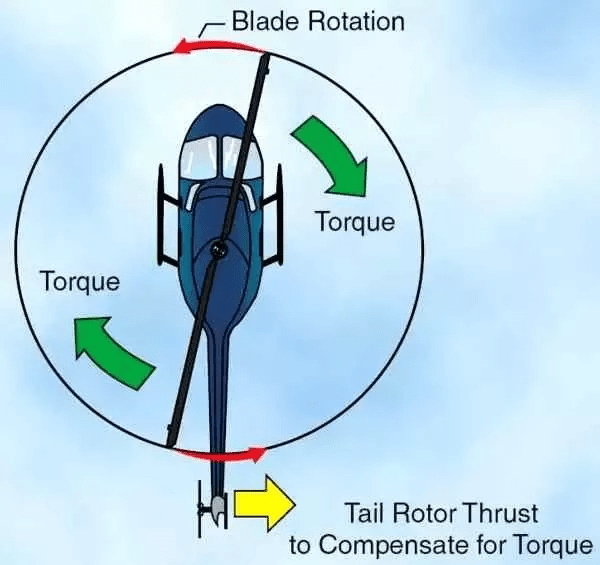
Naturally, the torque produced by the main rotors would spin the helicopter’s body in the opposite direction of the rotor blades. This is where the tail rotor comes into play. The tail rotor generates thrust in the opposite direction to counteract this torque, keeping the helicopter stable and allowing the pilot to control the helicopter’s heading using the rudder pedals.

 Beginner Engineer
Leave a comment